Dog anesthesia: how safe it is, the risks, and how cats differ
What anesthesia does to a dog or cat, how the veterinary team judges risk, and which questions belong in the admission call rather than at the door.
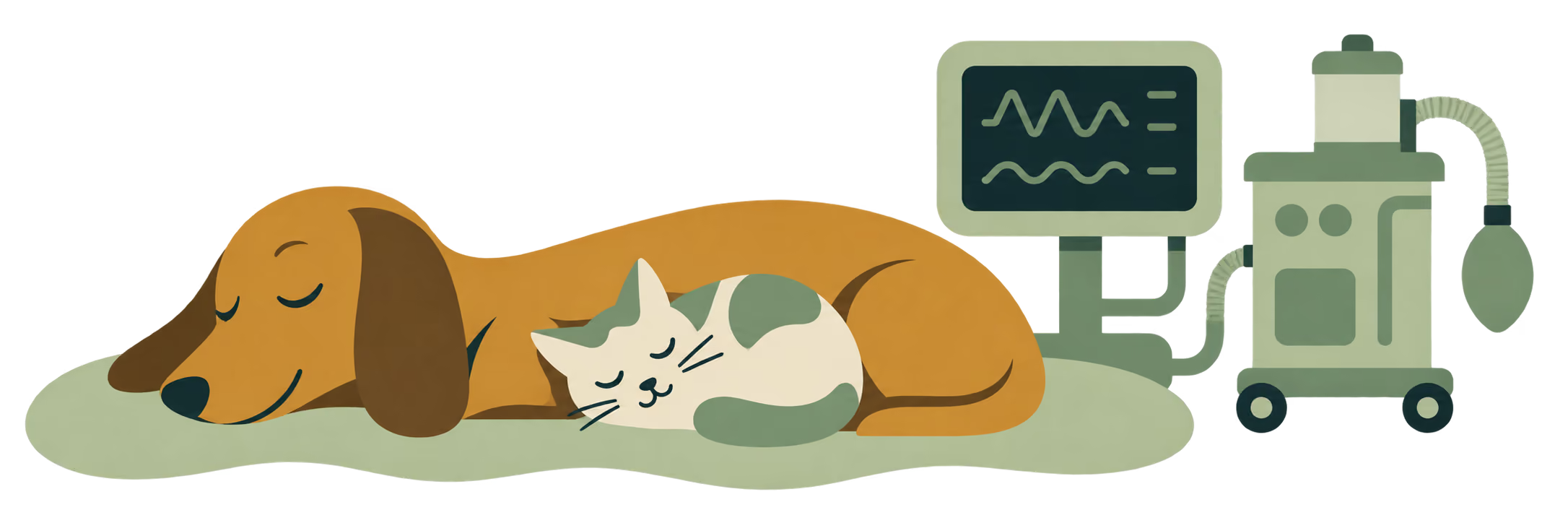
Find the guide for your next question.
Is anesthesia safe for dogs and cats? Nine practical guides help you prepare, understand the procedure, manage pain and support a smooth recovery.
The pre-anesthetic check
The questions on the admission form, the heart and lung exam, which blood panel suits which pet, and what to sign.
Fasting before anesthesia
The AAHA food and water ranges, which morning tablets still go down, and how puppies, diabetic pets, cats and rabbits differ.
How anesthesia works
What the premed, the induction drug, the tube, the vaporizer and a nerve block each do, and which step owners can influence.
Monitoring every vital sign
ECG, pulse oximetry, CO2, blood pressure and temperature, the depth signs no machine shows, and what the paper record catches.
Managing pain
Pre-emptive and multimodal pain relief, nerve blocks, the main drug classes without doses, and four questions to ask at discharge.
Signs of pain
Posture, face, appetite and grooming changes set side by side, the Glasgow and grimace scales, and the signs that cannot wait.

Anesthesia for horses
Why getting up is the hard part, when standing sedation wins, field versus hospital procedures, and what colic surgery demands.
The specialist's role
Residency and the DACVAA or DipECVAA letters, hospital pain services, VTS technicians, and the patients who justify a referral.

Waste anesthetic gas
The leaks behind most staff exposure, the NIOSH limits, active versus passive scavenging, badge testing and the pregnancy question.
Is anesthesia safe for dogs and cats? For a healthy pet the risk is very low, low enough that a planned procedure should not be put off out of fear. In an older pet, health matters more than age (the guide for older pets explains why), and the pre-anesthetic check is where the veterinary team judges the risk for that particular animal.
The parking lot is still half empty at ten to eight. A spaniel who has missed breakfast is pulling toward the door, and the person holding the leash has a list of questions that seemed urgent at midnight and now feel hard to put into words. Most of them come down to one: is anesthesia safe for dogs like this one, today, for this procedure?
Modern dog anesthesia is very safe for healthy animals and carries more risk for sick ones, and most of what decides the outcome happens in the clinic’s preparation, not in luck. The same is true of cat anesthesia, with a few differences that matter. This section of Napwell covers both species, from the first check to the drive home.
What general anesthesia does, and how sedation differs
General anesthesia is a controlled, reversible loss of consciousness. The patient does not feel pain during the procedure, does not move, and does not remember it. To get there safely the team usually combines several drugs, each doing part of the job: a sedative to calm, a pain reliever, an injected drug to bring on sleep, and a gas to hold it.
Sedation is a different state. A sedated dog is drowsy and relaxed, often lying still enough for an x-ray or a nail trim, but the reflexes that protect the airway still work and a strong stimulus will rouse it. That makes sedation the right tool for short, painless jobs and the wrong one for surgery or for cleaning teeth below the gumline, where the airway has to be protected by a tube and the patient must not move at all.
Owners sometimes ask for sedation because it sounds gentler. It is not always the safer choice, and a good clinic will say so, even when a sedation-only visit would be quicker and cheaper to book. A deeply sedated animal with an unprotected airway can be in a worse position than an anesthetized one with a tube in place and someone watching every breath.
Who is in the room during dog anesthesia
In a typical general practice the team is small. A veterinarian performs the procedure and is responsible for the anesthetic plan. A credentialed veterinary technician or nurse (the title depends on the country) often places the catheter, helps with induction and then does the monitoring, which means watching the patient and the machines continuously and writing readings into the anesthetic record. Larger hospitals and referral centers may also have a veterinary anesthesiologist, a specialist who has completed residency training and board certification. Knowing what a veterinary anesthesiologist does makes it easier to tell when one is worth asking for.
The detail worth asking about is not the number of people. It is whether one person’s only job during the procedure is the anesthetic. The 2020 AAHA Anesthesia and Monitoring Guidelines for Dogs and Cats describe exactly that: a trained team member dedicated to monitoring from induction through recovery. What that person watches, and why, is laid out reading by reading under anesthesia monitoring.
How the veterinary team assesses risks before the day
Before any drug is given, the veterinarian takes a history, examines the animal and, in most cases, looks at blood results. The aim is to find anything that changes the plan: a heart problem, a kidney that is not clearing waste well, a liver that will be slow to break down drugs, dehydration, or an infection. Each part of that check has its own logic, and owners can help with most of it.
Many clinics then put the patient into a class on a five-point scale borrowed from human medicine, the American Society of Anesthesiologists (ASA) physical status classification. It is a description of how sick the animal is going in, not a prediction for any single patient, and it is useful because higher classes line up with higher risks in published studies.
| ASA class | Plain-English meaning | Example |
|---|---|---|
| I | Normal, healthy patient | Young dog booked for a neuter |
| II | Mild disease that is well controlled | Older dog with early, stable arthritis |
| III | Severe disease that limits the patient | Cat with kidney disease, dog with a heart murmur and early signs of heart failure |
| IV | Severe disease that is a constant threat to life | Dog with a twisted stomach, cat in heart failure |
| V | Not expected to survive without the procedure | Patient in shock after severe trauma |
An “E” after the number marks an emergency, for example “III E”. It signals that there was no time to stabilize the patient or run every test, which raises the risk on its own.
Is anesthesia safe for dogs and cats?
For most healthy patients, yes. The best-known large study is the Confidential Enquiry into Perioperative Small Animal Fatalities (CEPSAF), a UK study published by Brodbelt and colleagues in 2008. It followed anesthetics in a large number of practices and put the overall risk of anesthesia-related death at roughly 0.17 percent for dogs and 0.24 percent for cats, about one in 600 dogs and one in 420 cats. Healthy animals in ASA classes I and II sat well below those averages, and sick animals well above.
Two findings from that study are more useful to owners than the headline numbers. First, a large share of deaths happened after the procedure had ended, in the hours of recovery, which is why monitoring should not stop when the gas is switched off. Second, the risk climbed with the patient’s ASA class and with emergency cases. The data were collected in the early 2000s and monitoring has become more common since, so these figures are best read as a guide to where risk sits, not as a current rate for any clinic.
So is anesthesia safe for dogs in general? It is safe enough that an elective procedure in a healthy animal should not be put off out of fear. Dog anesthesia has also changed since those data were gathered: pulse oximeters, capnographs and blood pressure monitors that were once found mainly in referral hospitals now sit in many first-opinion clinics. For a sick or older dog, the right question is narrower: is it safe for this dog, with this plan, at this clinic?
What raises the risks, and what lowers them
Age
Age matters less than health. A healthy twelve-year-old Labrador can be a better candidate than a five-year-old with untreated heart disease. Older animals do have less reserve, which means they cope less well with low blood pressure, cold and long procedures, so they tend to get more blood work, more fluids and closer attention to temperature. The very young carry their own problems: puppies and kittens lose heat fast, run low on blood sugar quickly, and their livers handle some drugs more slowly.
Flat-faced breeds
Brachycephalic dogs such as Pugs, French Bulldogs, English Bulldogs and Boston Terriers have narrow nostrils, a long soft palate and often a small windpipe. Under sedation those soft tissues relax and the airway can close. These dogs are also more prone to regurgitation. A good plan for them means minimal sedation before the airway is secured, a tube left in place until the dog is properly awake and swallowing, and someone sitting with the dog through recovery. Flat-faced cats such as Persians share some of the same airway issues.
Heart, kidney and liver disease
A weak or irregular heart may not tolerate the drop in blood pressure that many anesthetic drugs cause. Kidneys depend on steady blood pressure, so a patient with kidney disease usually gets intravenous fluids and careful pressure monitoring. Liver disease slows the breakdown of many drugs and can affect blood clotting. None of these rules anesthesia out. Each changes the drug choice, the fluids and how closely the patient is watched.
Weight
Obesity makes breathing harder under anesthesia because the chest and abdomen press on the lungs, and it complicates drug dosing, which is usually based on an estimate of lean weight. Where a procedure is not urgent, some veterinarians suggest weight loss first, even a modest amount over a couple of months, because it makes both the anesthetic and the recovery easier.
What lowers risk
The factors that make dog anesthesia safer are mostly unglamorous, and they apply to cats just as much: a complete history, a proper exam, blood work where it is indicated, a fasting plan that matches the patient, an intravenous catheter, a secured airway, active warming, pain relief that starts before the first cut, and a person watching the patient all the way into recovery. Fasting before surgery is one of the few parts owners control directly.
Cat anesthesia: why cats are not small dogs
In the CEPSAF data cats carried a higher risk than dogs, and anyone who works in a mixed practice will offer reasons. Cats are small, so they lose body heat quickly and are easy to overload with intravenous fluid. Their larynx is prone to spasm when touched, which is why many teams spray it with a local anesthetic before placing a breathing tube. The windpipe is delicate, and an overinflated tube cuff can damage it. Heart disease in cats, particularly hypertrophic cardiomyopathy, can be present without any murmur. And cats hide illness well, so an older cat may arrive with kidney disease or an overactive thyroid that nobody has noticed.
Good cat anesthesia therefore leans on quiet handling, a careful pre-anesthetic exam, blood work in middle-aged and older cats, warming from the start, measured fluids and gentle airway technique. It also leans on a calm recovery space away from barking dogs, because a frightened cat waking up can injure itself.
A word on medicines at home: cats lack some of the liver pathways other species use to clear drugs. One tablet of ibuprofen, naproxen or acetaminophen (paracetamol) from a household medicine cabinet can poison a cat, and the same tablets put dogs at risk too. Pain relief after cat anesthesia should only come from the clinic.
Questions to ask before the day
The best time for questions is the consultation or the admission call, not the moment of drop-off. A short list covers most of what matters:
- Who will be monitoring the anesthetic, and is that their only task during the procedure?
- Which blood tests are planned, and what would change if one came back abnormal?
- Will there be an intravenous catheter and fluids?
- How will pain be managed during the procedure and at home?
- When should food and water stop, and which morning medications should still be given?
- Who will call with an update, and what time is pick-up likely to be?
Quick, unruffled answers usually mean the clinic has been asked before and has its own routine. For the evening itself, the first hours after anesthesia sets out what is normal at home and what is not.
If your pet is sent home still drowsy, who answers the phone at 10 pm?
Horses too
Horses need anesthesia, pain management and careful monitoring too. The approach is similar in its goals and different in almost every practical detail, from standing sedation to the padded box where a horse wakes up.
Explore equine anesthesiaFrequently asked questions
Can my dog have anesthesia if it has a heart murmur?
Often, yes. A murmur is a sound, not a diagnosis, and many dogs with a soft murmur are anesthetized without trouble. The clinic may want to know what is causing it first, which can mean chest x-rays, a heart ultrasound or a cardiac blood test. The answer changes the drugs chosen and the fluid plan more often than it cancels the procedure.
Read about the pre-anesthetic checkWhy does the clinic ask for my phone number on the day?
The team needs to reach the owner quickly if they find something unexpected, such as a second lump, a broken tooth that needs extracting, or a change in the blood results. Owners who cannot be reached usually leave the clinic to make a decision without them, or to wake the patient and book a second anesthetic later, which nobody wants.
Is it normal for a dog to be wobbly or whine after waking up?
Some wobbliness, a slightly glazed look and a few hours of extra sleep are common on the day. Whining or crying can come from pain, from the after-effects of the drugs, or from the confusion of waking somewhere unfamiliar. The clinic should explain what to expect at discharge and who to call if the dog seems distressed or will not settle by the evening.
Read about the first hours after anesthesiaDoes a short procedure mean a lighter anesthetic?
Not really. A dog having a ten-minute lump removal goes through the same steps as one having a longer operation: premedication, induction, a secured airway and continuous monitoring. Shorter procedures do mean less time under gas and usually a quicker recovery, but the preparation and the checks before and after stay the same.
Read how anesthesia works, step by stepSources and further reading
Explore the original publications behind this guide.
Keep reading
The pre-anesthetic check
The questions on the admission form, the heart and lung exam, which blood panel suits which pet, and what to sign.
Monitoring every vital sign
ECG, pulse oximetry, CO2, blood pressure and temperature, the depth signs no machine shows, and what the paper record catches.
Fasting before anesthesia
The AAHA food and water ranges, which morning tablets still go down, and how puppies, diabetic pets, cats and rabbits differ.