Signs of pain in dogs and cats, and how vets score it in the clinic
Dogs and cats rarely cry out when they hurt. They change how they sit, eat, groom and look at people, and those changes can be read if you know where to look.
Updated
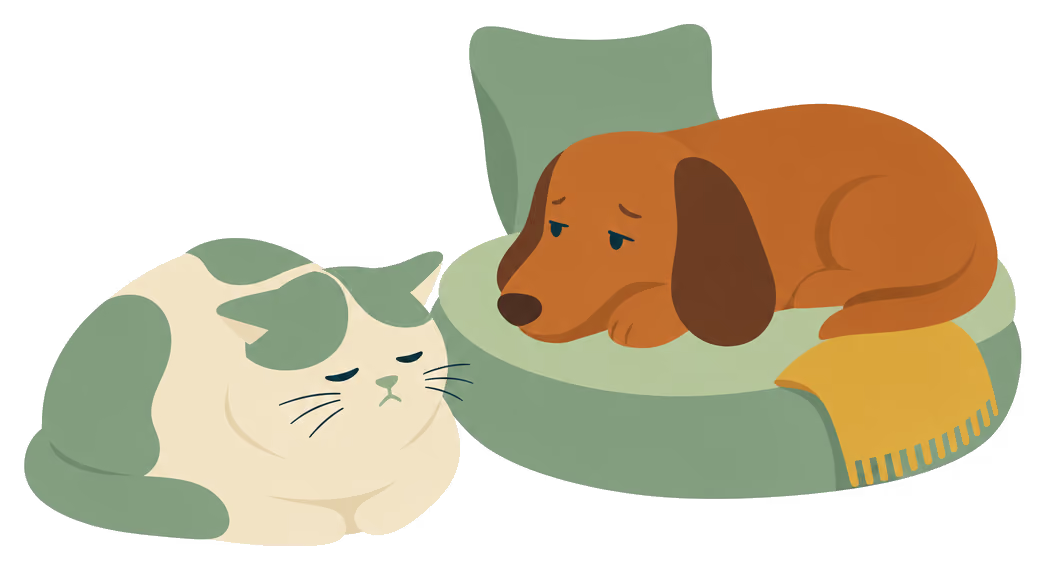
The signs of pain in dogs are quieter than most people expect, and the signs of pain in cats are quieter still. Pain shows as change, and animals did not evolve to advertise it.
Picture a cat that comes home from her dental at five in the afternoon and by seven is at the back of the closet, sitting in a tight loaf with her paws tucked under, her head a little lower than usual and her eyes half closed. The family dachshund keeps wandering over to look at her and then going back to his bed. Nobody is sure whether she is sleepy or hurting, and that uncertainty is normal.
Why pain is so easy to miss
A prey animal that limps or cries draws attention, and cats are both predator and prey. They tend to go still and hide. Dogs are more social and more likely to show discomfort to the people they trust, but many are stoic, and a dog that greets you at the door with a wagging tail can still be sore an hour later lying alone. After surgery there is a second layer of confusion, because the drugs used during anesthesia and for pain relief cause their own drowsiness, unsteadiness and odd behavior, and the first day after anesthesia has its own list of harmless after-effects.
Owners often ask the veterinary team how to tell if a dog is in pain, and the most useful answer is the animal’s own normal. The same is true of slow, long-running pain: an older dog that takes longer to rise, or a cat that stopped using the top of the bookcase, is often written off as simply getting old, a trap that caring for senior pets looks at closely.
Temperament matters as much as species. A boisterous young Labrador may carry on chasing a ball on a sore paw, while a nervous rescue greyhound may freeze at the first twinge. Neither reaction says how much it hurts; each says how that particular animal copes, which is why the same sign can mean a lot in one pet and very little in another, and why the people who live with the animal tend to notice first.
Behavior and posture: what changes first
For anyone working out how to tell if a dog is in pain, the early changes are often restlessness and an inability to get comfortable: lying down, standing up, turning, lying down again. Some dogs pant in a cool room or tremble. Others go the opposite way and become flat and withdrawn, uninterested in the people they usually follow from room to room. A dog that growls or snaps when someone reaches for a sore area is not being bad-tempered. It is protecting the spot.
Posture says a lot. A dog with abdominal pain may stand with its back arched and belly tucked up, or adopt a “prayer” position with the front end down and the rear up, which stretches the abdomen. A dog with a painful leg shifts weight off it, sits with that leg sticking out, or will not take the stairs it used to run up.
Cats more often withdraw. A painful cat hides, sits hunched with the head lowered and the feet tucked in, and may stay in one position for hours. It may stop jumping onto the bed or the windowsill. Some cats become unusually clingy instead, and some hiss at handling they normally enjoy.
Signs of pain in dogs and cats, side by side
A pet’s own ordinary evening is the yardstick: pain shows as a departure from it, not as a cry.
The table below sets the common signs of pain in dogs and cats next to each other. No single sign proves pain, and several together are far more telling than one.
| Sign | In dogs | In cats |
|---|---|---|
| Behavior | Restless, pacing, cannot settle, or unusually quiet and withdrawn | Hiding, staying in one place, less interaction, sometimes unusual clinginess |
| Posture | Hunched back, tucked belly, “prayer” position, weight shifted off a leg | Hunched loaf with head lowered, feet tucked, reluctance to stretch out |
| Face | Ears pulled back, tense or squinting eyes, fixed stare, lips drawn back | Ears flattened or turned out, squinting eyes, tense muzzle, whiskers straightened |
| Appetite | Eats slowly, drops food, refuses treats it normally loves | Stops eating or eats very little, often the first sign owners notice |
| Grooming | Licks, chews or stares at one spot, often the wound | Stops grooming (coat looks scruffy), or over-grooms one area until it is bald |
| Movement and toilet | Reluctant to climb, jump or go for walks, struggles to squat | Stops jumping, urinates or defecates outside the litter box, sits awkwardly in it |
The face tells more than it seems
Faces were long overlooked in veterinary pain assessment, but research in recent years has shown how much they reveal. In cats the change is striking once you see it: the ears rotate outward and flatten, the eyes narrow, the muzzle draws tighter and more oval, the whiskers straighten and point forward rather than curving loosely, and the head drops below the line of the shoulders.
In dogs the face is harder to read because of the variety of breeds, from flat-faced bulldogs to long-nosed sighthounds, but owners often describe a worried look: ears back, the skin of the forehead tense, eyes that are partly closed or that avoid contact.
How veterinary teams score pain
Clinics increasingly use published pain scales so that two different people on two different shifts can judge the same animal in the same way, and so that pain relief is given according to a score rather than a guess.
For dogs, the most widely used is the Glasgow Composite Measure Pain Scale, short form, developed at the University of Glasgow. A trained person works through a fixed series of observations and interactions: whether the dog is vocalizing, whether it attends to the wound, how it moves, how it responds when gentle pressure is applied near the painful area, its overall demeanor and its posture. Each answer carries a score, and the total helps decide whether more pain relief is needed. The scale is designed for acute pain in hospital, such as after surgery.
For cats, the Feline Grimace Scale, published in 2019 by researchers at the Université de Montréal, scores five features of the face: ear position, orbital tightening (how narrowed the eyes are), muzzle tension, whisker change and head position. Each is scored from 0 to 2. It is quick, it can be done without handling the cat, and it has been tested in a range of clinical settings, which is why it spread fast.
Colorado State University also published acute pain scales for dogs and for cats, which combine drawings of typical postures with written descriptions and a simple graded score. Many general practices use them because they are easy to teach and quick to apply.
None of these scales asks whether the animal is “being brave”. They measure what is visible, and that is their strength. What the team does once a score says the plan needs adjusting is the subject of pain management for dogs and cats.
Long-running pain and how it hides
Pain after surgery has a clear start and, with luck, a clear end. Long-running pain, most often from arthritis, creeps in over months, and its signs are easy to file under age or temperament.
The slow signs of pain in dogs with sore joints are stiffness when rising after a rest, a longer pause before the stairs or the car, shorter walks that end with the dog lagging behind, less interest in play, and licking at a wrist or knee. Some dogs sit with one hind leg stuck out to the side, and some become grumpy with other dogs that bump into them. None of these on its own proves arthritis, but together they are worth a visit.
Cats are harder again. A cat with stiff joints rarely limps. It stops jumping onto the kitchen counter, uses a chair as a step to reach the bed, misses the litter box because climbing into it hurts, and lets the fur along its back go matted because twisting around to groom is uncomfortable. Owners often describe the cat as having become lazy or old, and the change only makes sense once someone suggests pain.
For these slower problems, veterinary teams sometimes use owner questionnaires rather than in-clinic scales, such as the Canine Brief Pain Inventory or the Liverpool Osteoarthritis in Dogs (LOAD) score, and for cats the Feline Musculoskeletal Pain Index. They ask about everyday activities over weeks, because a single visit shows very little. A dog that walks a little stiffly into the exam room can look perfectly comfortable once its adrenaline is up.
What to note or film for the vet
A clinic phone call goes much better with specifics, and the discharge sheet from the first days of recovery at home usually lists the number to use. Note when the change started, whether it is getting better or worse, what the animal has eaten and drunk, when medicines were last given, and whether it has passed urine and stool. A short video is often worth more than a description, because many animals brighten up the moment they reach the clinic. Film the animal from a little distance without calling it, so it is not reacting to you: lying in its bed, getting up, walking across the room, climbing a step, and if it is a cat, sitting in its usual spot. A close photo of the face in good light can help a nurse apply exactly the kind of facial scoring described above.
A simple daily note helps too, especially over the first week after surgery or while a new long-term medicine is being tried: one line each evening on appetite, sleep, walks and anything odd. Trends that are invisible from one day to the next are obvious on a page, and the note gives the veterinary team something firmer than a general impression.
Ask the clinic first whether it accepts videos and how they should be sent. Some practices prefer them by email, some through an app, some not at all.
When it is urgent
Most signs of pain in cats and dogs after a routine procedure call for a phone call during opening hours. Some do not wait. Contact the clinic or an emergency service straight away if the animal:
- cries out repeatedly, cannot settle at all, or is getting worse rather than better
- breathes rapidly or with effort at rest, or has pale or bluish gums
- has a swollen, hard or rapidly enlarging belly, or retches without producing anything
- strains to urinate and produces little or nothing, especially a male cat
- has a wound that is bleeding, gaping or has something protruding from it
- collapses, cannot stand, or cannot be properly woken
A male cat straining in the litter box is the one that owners most often underestimate. A blocked urethra can become life-threatening within a day, and the cat may look as though it is constipated.
If the cat in the closet is hungry and sore in about equal measure, a soft meal at nine and the evening dose of her pain medicine may be all she needs, and by morning she could be back on the windowsill. If the dachshund has stopped checking on her by then, that is a fair sign too.
Frequently asked questions
Does a purring cat mean the cat is not in pain?
No. Cats purr when they are content, but also when they are stressed, unwell or in pain, and some purr loudly while recovering from surgery or injury. Purring on its own tells you very little. Look at the rest of the picture instead: posture, eyes, appetite, grooming, and whether the cat moves around the house the way it normally does.
How long should a pet be sore after a routine operation?
It depends on the procedure, but the direction matters more than the number of days. After most routine soft-tissue surgery, discomfort should ease a little each day, and the clinic sets the length of the home medicine course to match what it expects. Bone and joint surgery usually takes longer. Soreness that stays the same or gets worse after the first couple of days is a reason to call.
Read about recovery at homeShould I score my own pet with the Glasgow or grimace scale at home?
The scales were designed and tested for use by trained veterinary staff, so a home score is not a diagnosis. Reading about them is still useful, because they show which signs matter. Some clinics give owners a simple checklist based on them for the days after surgery. Describing what you see is often more helpful than giving the clinic a number.
Can I give my pet a human painkiller if it seems sore?
No. Ibuprofen, naproxen and acetaminophen (paracetamol) are dosed for people, and amounts that look tiny can cause stomach ulcers or kidney damage in a dog and fatal poisoning in a cat. They also clash with the anti-inflammatory the clinic may already have prescribed. Tablets left over from another pet are no safer. If the prescribed medicine seems not to be enough, call the clinic and describe what you see.
Read about pain managementSources and further reading
Explore the original publications behind this guide.
Keep reading
Managing pain
Pre-emptive and multimodal pain relief, nerve blocks, the main drug classes without doses, and four questions to ask at discharge.
The hours after anesthesia
How long grogginess, a croaky bark and wobbly back legs usually last, and the table that separates them from a real problem.
Recovery at home
How to set up a safe floor-level room, keep a medication sheet on the fridge, and spot the signs that need a call tonight.