Veterinary anesthesiologist: what a board-certified one does all day
Most pets are anesthetized safely by their own clinic's team. So what does a veterinary anesthesiologist do, and which few patients need a specialist who has spent years on nothing else?
Updated
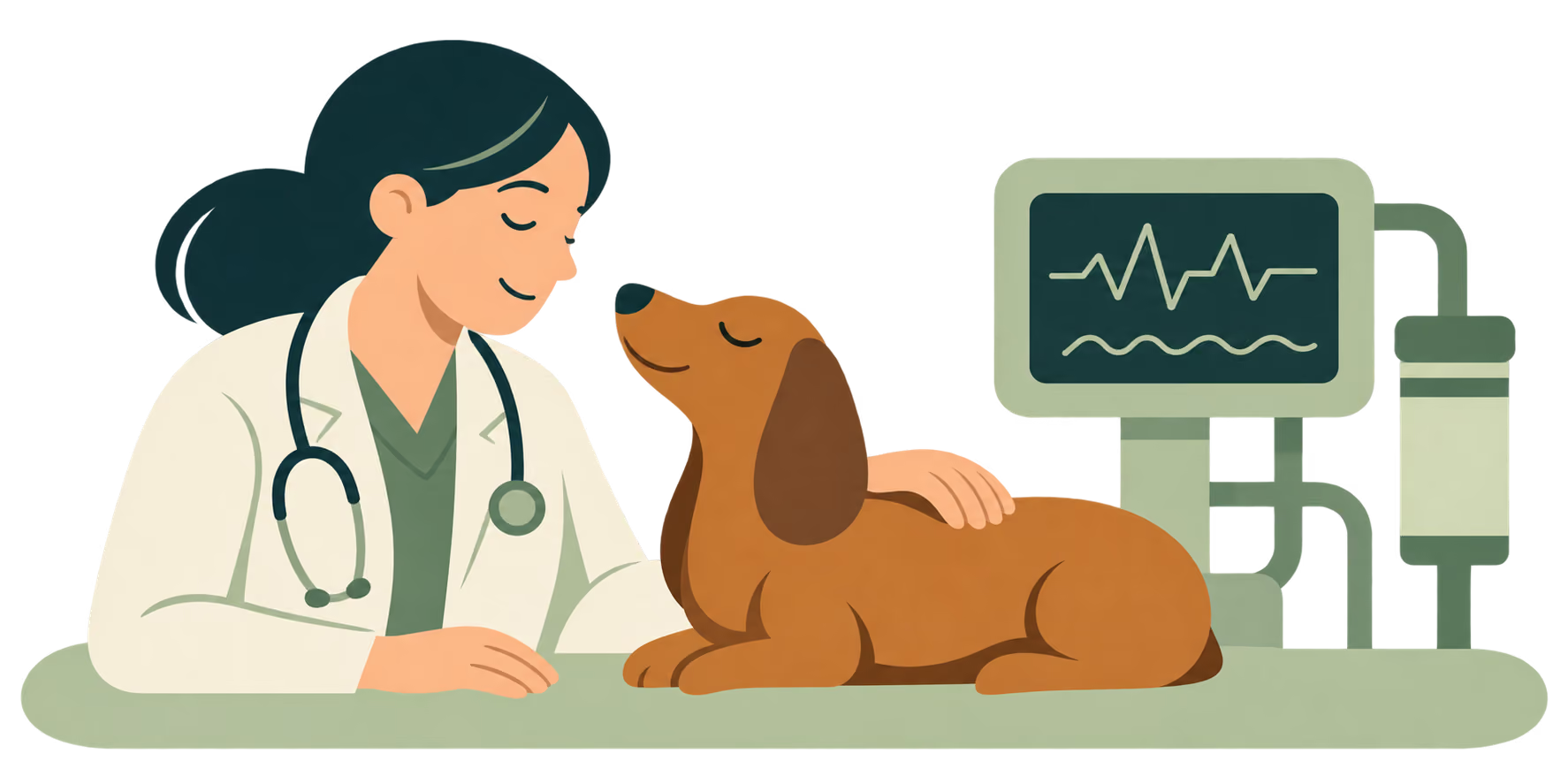
A veterinary anesthesiologist is a veterinarian who has trained for years after vet school in anesthesia and pain relief alone. Most pet owners never meet one, and most pets never need one.
The few that do are often the cases where it matters most.
Take a nine-year-old Cavalier King Charles Spaniel with a heart murmur, booked for a dental that needs several extractions. Its referral letter carries one line the owner reads twice: anesthesia to be managed by the specialist anesthesia service. The family vet has done hundreds of dentals. So what does a veterinary anesthesiologist do, day to day, that a busy general practice cannot?
What a veterinary anesthesiologist does in a hospital
On an ordinary weekday at a university teaching hospital or a large referral center, the day usually starts with a list of the cases booked for anesthesia and a review of each one: the history, the blood results, the heart and lung findings, the planned procedure. The specialist decides on a plan for each patient, including which drugs to use for premedication, induction and maintenance, how the patient will be monitored, which local anesthetic blocks will be used, and how pain will be handled afterwards.
The specialist does not necessarily hold every patient’s anesthetic in person. In a busy hospital several cases run at once, each with a resident in training or a technician at the patient’s side and the specialist moving between rooms, stepping in for induction, a difficult moment or a patient whose blood pressure is falling. For the highest-risk animals the specialist stays with the case throughout.
The patients who reach this kind of service tend to be the hard ones: animals with heart disease, a failing liver or kidneys, serious breathing problems, uncontrolled hormonal disease, recent trauma, very young or very old patients, and flat-faced breeds whose airways are narrow from the start. In the ASA physical status classification, which grades patients from I (healthy) to V (not expected to survive without the procedure), these are the animals graded III and above. Specialists also run anesthesia for long or complex surgery, such as spinal operations, chest surgery and major orthopedic repairs, and for imaging such as MRI, where the patient lies inside a magnet and the team has to monitor it from a distance with special equipment.
Part of the work is less visible. Anesthesiologists set the hospital’s protocols, check the equipment (including the scavenging that keeps waste anesthetic gas away from staff), teach the nurses and technicians, and are the people other clinicians call when something unexpected happens during a procedure. So the owner’s question, what does a veterinary anesthesiologist do, has a fuller answer than the operating room suggests: they plan, they troubleshoot and they teach, and the time at the patient’s side is only one part.
How a vet becomes a board-certified veterinary anesthesiologist
The route is long. In North America, a board-certified veterinary anesthesiologist has first completed a veterinary degree, then usually a one-year general internship or an equivalent period of clinical practice, then a residency of about three years in an approved program supervised by existing specialists. During the residency the trainee keeps a detailed log of cases, takes part in research and must publish a scientific paper in a peer-reviewed journal before sitting the certifying examination.
Years spent on nothing but anesthesia are what let a specialist see trouble coming in the patients most likely to have it.
The certifying body in North America is the American College of Veterinary Anesthesia and Analgesia (ACVAA). It was founded in 1975 as the American College of Veterinary Anesthesiologists and later added analgesia to its name, a sign of how central pain relief has become to the specialty. Those who pass its examination are called diplomates and may use the letters DACVAA after their name.
In Europe the equivalent body is the European College of Veterinary Anaesthesia and Analgesia (ECVAA). Its residency also runs at least three years in a standard program, followed by a two-part diploma examination, and successful candidates use the letters DipECVAA. Specialist status in Europe is recognized through the European Board of Veterinary Specialisation.
Put together, that is usually at least four years of further training after the veterinary degree, on top of the degree itself, and many anesthesiologists have also spent time in general practice before starting. A board-certified veterinary anesthesiologist has therefore usually seen, managed and studied far more complicated anesthetics than a busy general practitioner can, simply because that was the whole of their training.
Pain services, teaching and research
Many veterinary anesthesiologists run or contribute to a hospital pain service. Hospitalized patients after major surgery or trauma are assessed regularly with published pain scales, and the anesthesia team adjusts infusions, nerve catheters and medicines as the scores change. Some hospitals also offer outpatient clinics for chronic pain, where long-term conditions such as arthritis or nerve pain are managed over months. The approaches they draw on are the same layered ones described under pain management for dogs and cats, used more intensively.
Teaching is the other half at universities. Veterinary students learn anesthesia mostly from anesthesiologists, both in lectures and at the side of real patients, and residents are trained by them directly. Research ranges from how new drugs behave in different species to which local blocks work best for particular operations, and much of what general practices now do routinely, from pre-emptive pain relief to structured anesthesia monitoring, came out of that work.
The technician specialist at their side
Anesthesia is a team job, and the specialist rarely works alone. In North America, veterinary technicians can earn their own specialist credential in the field: the Veterinary Technician Specialist in anesthesia and analgesia, abbreviated VTS (Anesthesia and Analgesia). The credential is awarded by the Academy of Veterinary Technicians in Anesthesia and Analgesia, one of the specialty academies recognized by the National Association of Veterinary Technicians in America (NAVTA).
To earn it, an already credentialed technician has to document years of anesthesia experience, a detailed case log and advanced skills, and pass an examination. VTS technicians often run the anesthetic of an individual patient minute to minute, train other staff, and in some general practices act as the anesthesia lead for the whole clinic. Several European countries have comparable advanced qualifications for veterinary nurses in anesthesia.
When an owner might ask for one
Every anesthetic carries some risk, but the great majority of anesthetics in dogs and cats are planned and delivered safely by a general practice veterinarian with a trained technician or nurse watching the patient. A routine spay, a dental on a healthy young cat, or a lump removal on a fit dog does not need a specialist, and an owner should not feel that their pet is missing out.
There are situations where asking about a referral, or at least a specialist opinion, makes sense. The clearest is a patient with significant heart, lung, liver, kidney or hormonal disease, graded ASA III or higher at the pre-anesthetic check. Others include a pet that had a serious problem under a previous anesthetic, very young or very old animals needing major surgery, brachycephalic breeds with severe airway disease, long procedures, and animals whose pain after an earlier operation was hard to control. Horses, farm animals and exotic species are also commonly referred, because specialist equipment and experience with those species are concentrated in a few centers.
In practice the best route is through your own veterinarian. Ask directly whether this patient, for this procedure, would benefit from a specialist anesthetic, and what the nearest option would be. A good general practitioner will give a straight answer, and many will already have suggested a referral if they thought it necessary. A general practice can also ask a specialist for advice by telephone, which sometimes changes the plan without the animal leaving home.
What the day looks like with a specialist team
For the owner, a referral anesthetic feels different mainly in the conversations around it. The admission usually includes time with a member of the anesthesia team, sometimes the veterinary anesthesiologist, sometimes a resident or a VTS technician, who goes through the history again and asks questions the owner may not have been asked before: how the pet coped with previous sedation, whether it snores, how far it can walk before tiring, what it ate and when.
Expect a frank description of risk. Specialists tend to talk in specific terms about the patient in front of them, not in reassuring generalities, and some owners find that unsettling at first. It is a good sign.
During the procedure the monitoring is often more extensive than a general practice would use for a routine case, for example direct blood pressure measurement through a small catheter in an artery, or blood gas analysis to check how well the lungs are working. What the different drugs are doing during this time is the same sequence set out in how anesthesia works. After the procedure, the same team usually phones the owner, and the discharge notes often include a section written by anesthesia: what was used, how the patient behaved, and anything worth knowing for the next time.
That last part is valuable. Keep a copy of the anesthesia notes with your pet’s records, because they help any future clinic plan a safer anesthetic.
How to find a specialist
In North America, the ACVAA’s website includes a search tool for finding an anesthesiologist, which lists its diplomates. University veterinary teaching hospitals almost always have an anesthesia service staffed by board-certified veterinary anesthesiologists, and large private referral hospitals increasingly do too.
In Europe, the ECVAA’s website publishes the list of training centers accredited for its residency programs, which are by definition places with resident specialists. Referral hospitals generally list their staff with their qualifications, so the letters DipECVAA or DACVAA on a staff page are a quick check.
The limit is numbers. There are far fewer veterinary anesthesiologists than there are pets needing anesthesia, and in many regions the nearest one is hours away. Where that is the case, a referral is a trade-off between travel, cost and benefit, and only the clinic that knows the patient can weigh it properly. If the Cavalier with the murmur does go to the referral hospital, the line on the discharge notes that matters most to the owner is likely to be a short one, about blood pressure that held steady and a dog that ate its supper.
Frequently asked questions
Is a veterinary anesthesiologist the same as a veterinary anesthetist?
The words are used loosely and differ between countries. In North America, anesthesiologist usually means a veterinarian who has completed specialist training and certification in anesthesia. In the United Kingdom and elsewhere, anaesthetist is the common word and can refer to anyone delivering the anesthetic. The letters after the name, such as DACVAA or DipECVAA, are the clearer guide to specialist status.
Does a specialist anesthetic cost more?
Usually, yes. Referral hospitals with specialist anesthesia services have higher staffing and equipment costs, and the specialist's time is billed as part of the procedure. The difference varies a great deal between hospitals and countries. A referral hospital will normally give an estimate before the procedure, and it is reasonable to ask how much of it relates to anesthesia and monitoring.
What should I bring to a referral anesthesia appointment?
Bring every current medication in its packaging, a note of when each dose was last given, and copies of any earlier anesthetic records if the referral letter did not include them. Follow the hospital's own fasting instructions, which may differ from your usual clinic's, and write down the time food was removed. A short list of your own questions helps, because admission conversations move quickly.
Read about fasting before anesthesiaDoes a specialist anesthetic make the outcome certain?
No anesthetic is free of risk, whoever gives it. A specialist team lowers risk in complicated patients through detailed planning, extra monitoring and experience with rare problems, but it cannot remove the risk that comes from the disease itself. For a healthy pet having a routine procedure, the risk in a well-run general practice is already low, and a referral adds little.
Read about how safe anesthesia isSources and further reading
Explore the original publications behind this guide.
Keep reading

Monitoring every vital sign
ECG, pulse oximetry, CO2, blood pressure and temperature, the depth signs no machine shows, and what the paper record catches.

The pre-anesthetic check
The questions on the admission form, the heart and lung exam, which blood panel suits which pet, and what to sign.

Managing pain
Pre-emptive and multimodal pain relief, nerve blocks, the main drug classes without doses, and four questions to ask at discharge.